

Economic Review – August 2026
| Recent data shows the UK second-quarter growth was more resilient than anticipated – 0.4% growth | The latest Labour Market Overview published by ONS in August painted a muted picture of the UK jobs market | According to ONS, consumer spending slowed as the volume of goods sold fell by 0.5% over the month |
UK second-quarter growth more resilient than anticipated
Recent data shows the UK economy unexpectedly expanded by 0.4% between April and June, despite ongoing pressure on business costs and household finances.
Official figures from the Office for National Statistics (ONS) showed gross domestic product (GDP) growth slowed from 0.6% during the first quarter. Nevertheless, the result was stronger than economists anticipated, suggesting consumers were still responding well to recent economic disruption. Services and manufacturing were the main growth drivers, while warm weather and major sporting events, including the World Cup, boosted hospitality and leisure activity. June was particularly strong, with output increasing by 0.3% during the month. Chancellor John Healey responded by pointing out the UK had seen the “fastest growth in the G7 this year” but that it now needed to “double down and drive growth in every postcode.”
The positive growth data was accompanied by a less encouraging update on the public finances. Government borrowing reached £1.8bn in July, considerably higher than the £500m surplus forecast by the Office for Budget Responsibility (OBR). Borrowing since the beginning of the financial year now stands at £56.7bn. Although this is £6bn below the equivalent figure a year ago, thanks to higher tax revenues, it remains more than £2bn above the OBR’s projection. This could leave the new Chancellor with little room to manoeuvre on taxes or spending when he delivers his first Budget on 28 October.
Stuart Morrison, Research Manager at the British Chambers of Commerce, said the UK economy displayed “welcome resilience” in Q2, but added, “The headline figures shouldn’t disguise the cocktail of cost pressures choking long-term business growth. The Autumn Budget must be a game changer for stronger, sustainable growth. We need measures that boost trade, investment and productivity. The Chancellor must back business, cut costs and deliver growth.”
UK jobs market remains stable, but “stagnant” growth persists
The latest Labour Market Overview published by ONS in August painted a muted picture of the UK jobs market.
Job vacancies for the May to July period fell to 707,000, their lowest level in more than five years and a 6,000 decline from the previous three-month period. Businesses cited higher wage bills, including National Insurance contributions and the minimum wage, with rising operating costs as reasons for the hiring slowdown.
According to HMRC payroll figures, the number of payrolled employees fell by 78,000 in June compared to a year ago, a decline of 0.3%. Provisional estimates suggest employment fell again in July, leaving payroll numbers 94,000 below July 2025. However, ONS reported that the labour market was ‘little changed overall,’ with the unemployment rate unchanged at 4.9%.
Average pay has continued to rise, although growth remains varied across different parts of the economy. ONS reported regular earnings increased by 3.5% annually, while total pay, including bonuses, rose by 4.1%. Public-sector regular pay grew by 6.1%, compared with 2.8% in the private sector. After inflation, employees experienced modest real-term wage growth.
Graduate job openings have nearly halved over the past year, according to recruitment website Adzuna. It listed 8,383 graduate vacancies in July, compared with 15,397 a year earlier, the lowest total since its records began in 2016. Competition has also intensified across the wider labour market, rising to 2.14 applicants per vacancy from 1.93.
Alex Hall-Chen from the Institute of Directors called it a “stagnant” labour market, adding, “If the government is to deliver on its promise of growth and prosperity in every postcode, it must take concrete steps to restore employer confidence and support job creation.”
Markets
At the end of August, growing expectations of interest rate hikes by major central banks, aimed at containing inflation, weighed on investor sentiment. This followed Federal Reserve Chair Kevin Warsh’s keynote speech at the annual Jackson Hole Economic Policy Symposium on 28 August.
Warsh adopted a more hawkish stance on interest rate policy than widely expected, reiterating his focus on bringing inflation back towards target, while offering little guidance on the future direction of monetary policy. This came against the backdrop of a robust second-quarter earnings season in the US.
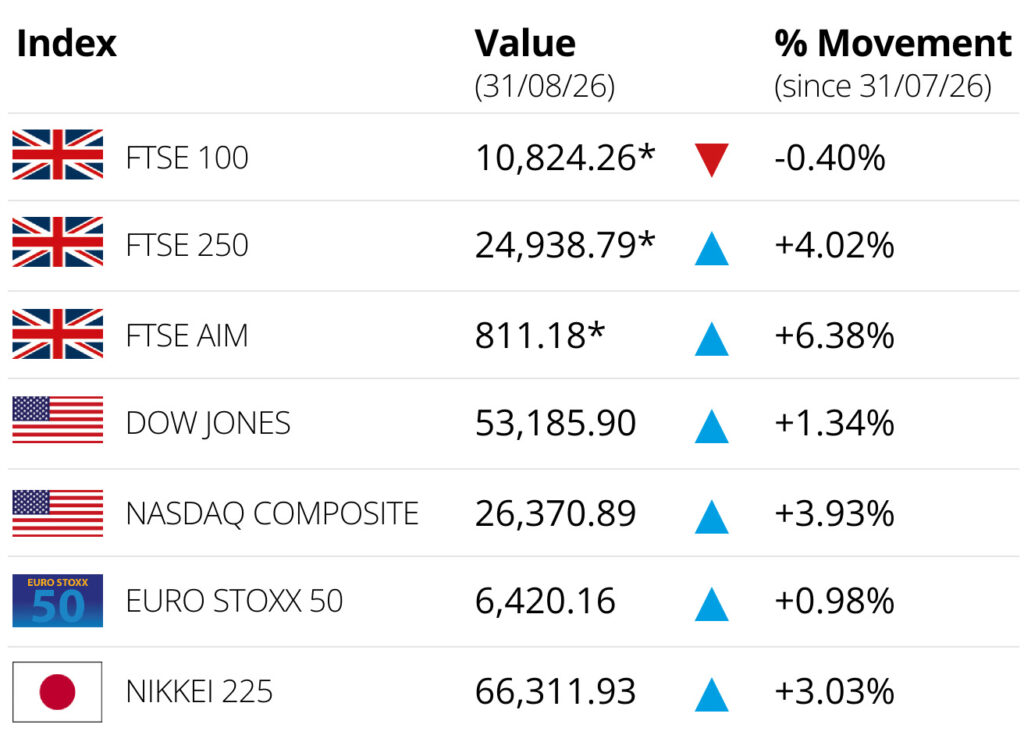
The Dow Jones gained 1.34% in August to close on 53,185.90. The tech-focused NASDAQ recorded a monthly gain of 3.93% to close on 26,370.89.
In the UK, the blue-chip FTSE 100 closed the month down 0.40% on 10,824.26, while the FTSE 250 gained 4.02% to close on 24,938.79. The FTSE AIM Index increased 6.38% to close on 811.18. On the continent, the Euro Stoxx 50 rose 0.98% over the month to close at 6,420.16. The Nikkei 225 registered a 3.03% gain in August, closing at 66,311.93. Japanese bond yields climbed to fresh highs at month end, reflecting growing expectations for tighter monetary policy.
On the foreign exchanges, the euro closed the month at €1.16 against sterling. The US dollar closed at $1.35 against sterling and at $1.16 against the euro.
A direct exchange of fire between the US and Iranian militaries sent oil prices higher towards the end of August. Brent crude oil closed the month down over 2% at $88.23 a barrel. Gold closed August trading around $4,484 a troy ounce, a gain of over 9% in the month.
Retail sales wilt as temperatures soar in July
Consumer spending slowed in July, according to ONS. The volume of goods sold in stores and online fell by 0.5% over the month, in sharp contrast to the rise of 0.7% for the previous month. The fall was predicted by economists.
Food and drink sales were a notable bright spot, increasing 3.8% year-on-year in July, in part due to the World Cup and England’s run to the semi-finals. However, non-food sales in stores were affected by the hot weather, falling 1.3% as shoppers opted to stay home. Clothing sales were down in July, which was in part attributed to retailers bringing forward summer sales to May and June. Consumers also appeared to delay purchasing big ticket items such as furniture and computers.
Helen Dickinson, Chief Executive at the British Retail Consortium, said, “Consumer demand has struggled in the heat, leaving retailers facing a challenging start to the second half of the year. Household budgets remain stretched, consumer confidence is fragile and retailers continue to grapple with rising operating costs.”
Higher energy costs and heatwaves push UK inflation back up
The annual rate of UK inflation rose to 2.9% in July, a notable jump from June’s 15-month low of 2.6% according to ONS. Analysts had predicted a Consumer Prices Index (CPI) reading of around 2.8%.
The increase was attributed to the impact of the Middle East conflict, with higher gas and electricity prices adding to the UK’s cost of living concerns. At the beginning of July, the energy price cap set by regulator Ofgem increased by an average of 13%, resulting in significantly higher bills for UK households. ONS reported ‘core’ inflation, which strips out the impact of energy, food, alcohol and tobacco, was higher than predicted at 2.6%. Chancellor John Healey said, “Iran war inflation continued to impact prices here at home, but Britain’s economy is resilient.”
The summer drought is set to leave Britain with smaller crop yields and higher grocery prices. The National Farmers’ Union warned of food shortages following poor yields for crops such as wheat, barley, rapeseed and oats, while vegetable producers running low on water are reporting quality issues. The poor conditions could lead to higher prices and ‘shrinkflation,’ where customers pay higher prices for goods in smaller quantities.
All details are correct at the time of writing (1 September 2026)
The value of investments can go down as well as up and you may not get back the full amount you invested. The past is not a guide to future performance and past performance may not necessarily be repeated.
It is important to take professional advice before making any decision relating to your personal finances. Information within this document is based on our current understanding and can be subject to change without notice and the accuracy and completeness of the information cannot be guaranteed. It does not provide individual tailored investment advice and is for information only. We cannot assume legal liability for any errors or omissions it might contain. No part of this document may be reproduced in any manner without prior permission.